Showing posts with label parent connect. Show all posts

Wednesday, December 9, 2015

Parent Connect: Kids and Screens

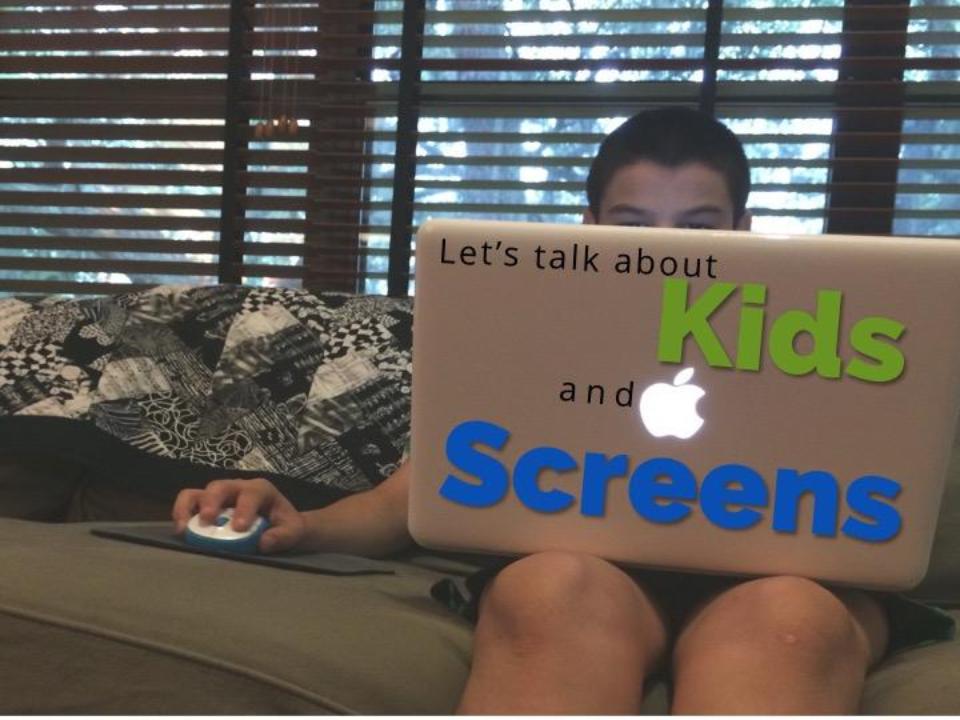
Karin Hallett and I, as part of our "Parent Connect" series of interactive discussions, recently facilitated a session called, "Kids and Screens."
Here are the slides and resources we shared:


We began by sharing our learning intentions which was mainly to create a space for informed and open discussion and sharing. We also wanted to bring to the light of consciousness the connection between our anxieties about kids' screen use and our own behavior with screens. 


It's always slightly amazing/shocking/overwhelming... to watch the numbers under "Society & Media" on the Worldometers site. It certainly makes a numerical case that our world is irrevocably a world of digital communication. Then we shared some information about media use of tweens and teens, as well as adults.


We also reviewed key ideas from the updated recommendations from the American Academy of Pediatrics Growing Up Digital Report. 

We finished our session by watching this thought-provoking TED Talk, "We Are All Cyborgs Now" by "cyborg anthropologist," Amber Chase. 


Monday, March 30, 2015

Parent Connect: What's So Great About Finland

Today, Karin and I shared a Parent Connect about education in Finland. It is not a topic about which I am very well-informed, so a lot of our preparation consisted of reading and learning. I have heard so much about Finland, and it was interesting to fill in some of the details and discuss with those in attendance.

We opened the session with this video, of which we showed the first 3:25 minutes.

We then shared some background information, including the following points:

  • 50 years ago, Finland had terrible ed system
  • education was a key part of Finland’s economic recovery plan
  • Now they are hailed internationally for extremely high ed outcomes (reading, math and science literacy over the past decade)

as well as sharing some background information about PISA, including:

  • In 2000, the first results of the PISA revealed Finland’s 15 year olds as the best young readers in the world
  • In 2003, Finland led in math, In 2006 they were first (out of 57 countries) in science, 2009 they were 2nd in science, 3rd in reading and 6th in math out of half a million students worldwide


We outlined the innovations that currently seem to be working in Finland.

We then asked participants to categorize these ideas into two groups on a T-Chart, dividing them into things that are normally associated with "traditional" education vs. "non-traditional" education settings. 

Further Reading:


And, for another perspective...(although I am not familiar with this source):


Monday, February 2, 2015

Parent Connect: Reading Lives Vs. Reading Levels

These are the slides from a recent Parent Connect session I led with Karin Hallett. We use AR at our school as a tool to help us in our choice literacy efforts. AR is far from a perfect tool, but it is what we have, and I find that it does help me acquire data that parents want. The problem is that parents can become overly attached to the numbers AR and STAR Reading provide. As a teacher, I assess my students' reading growth in a wide variety of ways, these tools (AR, STAR) being only one piece of the puzzle.

Karin and I have noticed with dismay how many parents are pushing their students to read higher AR book levels. I have had several students tell me, "I can't read that book (a book I have suggested I think they would really like). It's below my AR level, and my mom doesn't allow me to read books below my level." Karin has had parents come into the library demanding to know why their child isn't reading at a higher level.

Sadly, many parents seem to have the schooly belief that the whole point of reading is achievement and that pushing children to read higher-level books will equate to "better" readers. There is so much wrong with this I don't know where to start dismantling the argument. It's yet another symptom of the disease of schooliness we are suffer from here in the US (I can't speak for other countries, but I postulate that it is the same or worse in many other places in the world).


Parent Connect: Reading Lives vs. Reading Levels from Andrea Hernandez

Note: The carrot picture on the last slide. I really wanted to include that, as I love what it communicates. However, I've not been able to find a source for attribution. You can see that it is posted all over the web without attribution. If anyone can share a source, please do! In the meantime, I am going to leave it in my slides. 

Tuesday, December 9, 2014

Parent Connect: Quality Commenting

Karin Hallett and I run a parent/community education program at our school. We call it "Parent Connect" and it focuses on a variety of topics relate to the evolution of learning and literacy. Yesterday's session topic was quality commenting.

In preparation for the session, Karin worked with our 5th graders to create this fabulous video, which we used to set the tone.


Quality Commenting from MJGDS Classrooms on Vimeo.

Next, we used the following slides to structure our discussion about how blogging and commenting fit into a framework that uses blogging as one of the primary platforms for literacy instruction.


Some of the slides have corresponding blog posts.  Slide 5, "Creating for an Audience" relates to a post I wrote called, "I Hope You Like It." Slide 7, "Student Commenting Policies" showcases student examples which can be viewed at the post: "Writing Commenting Policies for Student Blogs."

Finally, we showed some examples of comment screenshots from some of our student blogs and discussed/evaluated in terms of quality.


I would love to get more quality comments on my blog as well as see more quality interaction on my students' blogs. What is it that I am missing or lacking? I am very open to and appreciative of feedback on this topic.

Monday, February 3, 2014

Authentic Literacy: What is it, Why Does it Matter & What Does it Have to Do With Soup?

From "Ed Tech" to Literacy…
Although I continue present my work under the brand of "edtechworkshop," my professional interests are moving away from "ed tech." Job-wise I have transitioned from (all titles in quotes because that is how I think of them) "technology coordinator" to "21st century learning specialist" to "Director of Teaching & Learning (as titles go, I like that one best) to my current job title of "4th/5th grade language arts teacher" (as the actual work goes, I like this one best).

When I was working with Silvia Tolisano to transform school culture, we recognized the importance of parent education and responded with monthly "Parent Connect" sessions.  We had a small but dedicated group who joined with us to discuss a variety of topics related to changes in learning and how our school was responding to those changes. It was of huge importance to the success of many initiatives, as that small group of parents acted as "ambassadors" spreading vital positivity and understanding throughout the parent community.

So, it was natural for me to turn back to the Parent Connect model as a way to build support and understanding for my non-traditional LA classroom. 
There is a great deal of fear that goes along with letting go and allowing learning communities to flourish without many of the trappings of the box known as school.

I am lucky to have a great partner in librarian Karin Hallett, and I have really enjoyed preparing for and presenting the sessions.
Our most recent session was, "Authentic Literacy: What is it and why does it matter?"
Here are the slides from that session:
Authentic literacy from Andrea Hernandez

If you're interested in some slide details or related articles, you can find that here.
But what I wanted to share here was the "soup analogy" that I described on slide #4. So many people commented afterwards how this idea really spoke to them.


I realize that at one time, processed, canned food was all the rage and seemed like the answer to all the problems of feeding the people. However, it didn't take long to figure out that an authentic, hand-crafted soup was not only more delicious but was healthier and generally the better all-around option. 

I imagine that many kids who grew up eating salty, tinny, canned soup decided that they didn't really like soup. Just like many kids who are growing up on a canned, uniform, pre-packaged reading curriculum believe that they don't really like reading. How sad that they have never tasted the real thing.